by Paul Scully | Mar 27, 2009 | News |
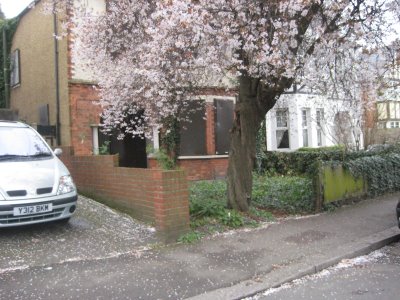
Last year Sutton was 6th in London for having the highest proportion of empty houses. Many of these were private homes. The Local Government Association has called on the Government to cut VAT on refurbishment work to encourage owners to bring them up to scratch and occupied. At the moment, new builds are exempt from VAT but refurbishment is not. A separate campaign, Cut the VAT has more details.
In the meantime, residents have been asking what is happening with the empty property in The Square. There have been security problems over the period whilst it has been empty. It has been earmarked for some residents moving from Orchard Hill in Carshalton. The Primary Care Trust seem to be the sticking point. I hope that they start to accelerate their efforts to rehouse people from Orchard Hill which was due to have been closed down last year. Whilst the delays continue to this major project, Stanley Park High School remains unbuilt, the property above remains empty and some residents remain in unsuitable accommodation.

by Paul Scully | Mar 26, 2009 | News |
This week’s Sutton Guardian had a story about the use of council jargon that was excellent in every regard apart from one. I was accused of using a bit of jargon myself, when in fact, I had only used it in a previous article slamming the use of council-speak. The bit of jargon was no ordinary word. It was ‘deliverology’; a word that I believe was first used in Tony Blair’s ‘Delivery Unit’. Both of the phrases in the last sentence should be committed to trial in the lexicographical equivalent of the Hague.
Anyway, here’s my response, which I hope that the Guardian will publish next week.
“I was somewhat surprised to see that I had been singled out for criticism for the use of the word “deliverology” (Tories call for end to waffling jargonology, Guardian 26.03.09). The only time that I have used this barmy word was when slamming its use in these pages last year. I have heard it used elsewhere but still have no clue what it actually means. I would be grateful if any readers can enlighten me.
I’m always happy to take criticism on board and I am my own biggest critic, but I think on this occasion my direction of travel has been tested for soundness by my colleagues and we are coterminous in that the outcome suggests that my use of the government lexicon is a predictor of beaconicity. Either that, or to translate for the real world, anyone that knows me would think that I am pretty jargon-free.”
by Paul Scully | Mar 24, 2009 | News |
Well worth watching SE England MEP Dan Hannan laying into Gordon Brown after the Prime Minister had addressed the European Parliament. Dan lays the charges at Gordon Brown’s feet in the most succint way that I have seen for sometime.
Update: After more than 600,000 views on the internet, the mainstream media are starting to report the speech. Someone with too much time on their hands has produced a transcript:-
Prime Minister, I see you’ve already mastered the essential craft of the European politician, namely the ability to say one thing in this chamber and a very different thing to your home electorate. You’ve spoken here about free trade, and amen to that. Who would have guessed, listening to you just now, that you were the author of the phrase ‘British jobs for British workers’ and that you have subsidised, where you have not nationalised outright, swathes of our economy, including the car industry and many of the banks? Perhaps you would have more moral authority in this house if your actions matched your words? Perhaps you would have more legitimacy in the councils of the world if the United Kingdom were not going into this recession in the worst condition of any G20 country?
The truth, Prime Minister, is that you have run out of our money. The country as a whole is now in negative equity. Every British child is born owing around £20,000. Servicing the interest on that debt is going to cost more than educating the child. Now, once again today you try to spread the blame around; you spoke about an international recession, international crisis. Well, it is true that we are all sailing together into the squalls. But not every vessel in the convoy is in the same dilapidated condition. Other ships used the good years to caulk their hulls and clear their rigging; in other words – to pay off debt. But you used the good years to raise borrowing yet further. As a consequence, under your captaincy, our hull is pressed deep into the water line under the accumulated weight of your debt. We are now running a deficit that touches 10% of GDP, an almost unbelievable figure. More than Pakistan, more than Hungary; countries where the IMF have already been called in. Now, it’s not that you’re not apologising; like everyone else I have long accepted that you’re pathologically incapable of accepting responsibility for these things. It’s that you’re carrying on, wilfully worsening our situation, wantonly spending what little we have left. Last year – in the last twelve months – a hundred thousand private sector jobs have been lost and yet you created thirty thousand public sector jobs.
Prime Minister, you cannot carry on for ever squeezing the productive bit of the economy in order to fund an unprecedented engorgement of the unproductive bit. You cannot spend your way out of recession or borrow your way out of debt. And when you repeat, in that wooden and perfunctory way, that our situation is better than others, that we’re ‘well-placed to weather the storm’, I have to tell you that you sound like a Brezhnev-era apparatchik giving the party line. You know, and we know, and you know that we know that it’s nonsense! Everyone knows that Britain is worse off than any other country as we go into these hard times. The IMF has said so; the European Commission has said so; the markets have said so – which is why our currency has devalued by thirty percent. And soon the voters too will get their chance to say so. They can see what the markets have already seen: that you are the devalued Prime Minister of a devalued government.
![Building The Foundations for Success]()
by Paul Scully | Mar 20, 2009 | News |
 As I go around speaking to residents, it is always interesting to hear about people’s perceptions of political parties. Not just the differences between them but how they believe that they work. I thought it may enlighten some to show a little of what goes on behind the scenes. When I turn up on someone’s doorstep, I haven’t been personally charged to do so by David Cameron. There is a big devolved structure that enables the Conservative Party to work across the country in a reasonably consistent way.
The Conservative party has three main branches, the Parliamentary Party, professionals and volunteers.
Most people immediately think of the first group as it is these people who they see in the media. There is a lot beyond Westminster. The professionals don’t just deal with press releases and research policy but also cover the mundane; helping organise local associations and providing support for IT, offices, printing etc. The often unsung volunteers number in the hundreds of thousands up and down the country, giving their time knocking on doors, stuffing envelopes, delivering leaflets. Contrary to popular belief, there is no magic way that a large wodge of money can provide an alternative to these fundamental basics.
Heading up all of this is the Conservative Party Board made up of all three sections of the party. They set the strategy, resolve tough problems, organise the party in the most efficient and effective way possible and slightly scarily become liable for the debts of the party as trustees. Below this for the voluntary side is the National Convention. This is largely made up of representatives from local constituencies. The top brass on this are elected and have a place on the Party Board.
Elections are coming up this spring with the results due on the 25th April. Three people are standing for chairman of the Convention, Simon Mort, Sir Graham Bright and Jeremy Middleton. Yes, even these elections require an online presence in order to get messages across the country in a short space of time. Each of the candidates talk about local volunteers having a greater say in choosing candidates and running their local associations. Localism is not just attractive for local government, the clamour has been there for greater devolution of power within the party organisation for sometime.
Three are also standing for the position of Vice President, Paul Swaddle (pictured), Fiona Hodgson and Charles Barwell. It is interesting to see the difference in approach in campaigning for the two roles. Certainly Paul and Charles have a sense of action. As someone well down the food chain in all of this, I am only interested in the structures and committees if I see them making a difference for me and the thousands of others who are trying to get the change we need through a Conservative government and a Conservative-run Council here in Sutton. Looking at some of the aims and objectives of the candidates, I get a sense of urgency from Jeremy Middleton and Paul Swaddle. I don’t have a vote but I would be content that these two would make the top-end of the Party relevant for more people within the Party, which should translate into success at the ballot box which is what we all give up our time for.
by Paul Scully | Mar 15, 2009 | News |
This week David Cameron took the step that our own Councillor, Tim Crowley asked Gordon Brown to take at “Any Questions” last week. Our local spokesman for Finance and Value for Money tackled Junior Minister Sadiq Khan, asking him why Gordon Brown wouldn’t acknowledge the part that he played as Chancellor and Prime Minister in the failure of the regulation of the banks and the proliferation of such high debt which makes the UK spectacularly badly positioned to weather the global credit crisis.

 Last year Sutton was 6th in London for having the highest proportion of empty houses. Many of these were private homes. The Local Government Association has called on the Government to cut VAT on refurbishment work to encourage owners to bring them up to scratch and occupied. At the moment, new builds are exempt from VAT but refurbishment is not. A separate campaign, Cut the VAT has more details.
