by Paul Scully | Nov 5, 2015 | News |
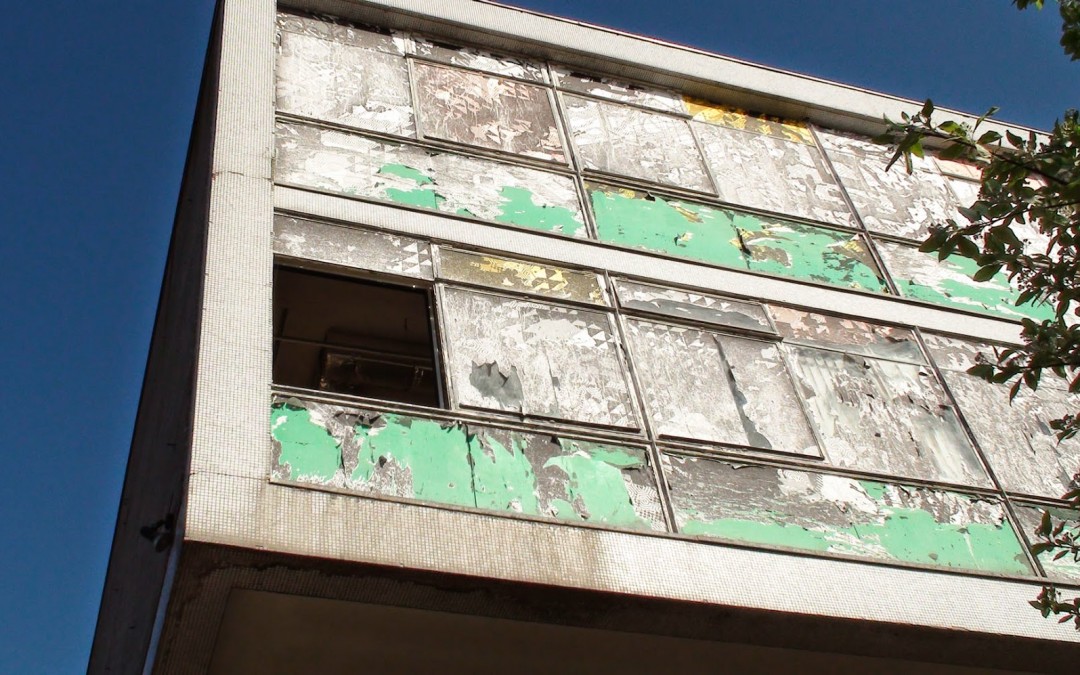
Victoria House, a familiar unsightly building in North Cheam, will hopefully soon be developed on.
Sutton Council and the developers hoping to build on the Victoria House site, HomeGroup, have successfully negotiated with Ladbrokes that they vacate the site, meaning demolition works are now able to take place, and a planning application is expected to be submitted immediately before or after the New Year.
In response to an email I sent, the Head of Development at HomeGroup gave me this update:
“I think when I discussed the scheme at the consultation we were in negotiations with Ladbrokes to agree a premium to buy out its lease. I can confirm that we were successful in doing so and Ladbrokes moved out of the premises at the end of September giving us full vacant possession of the site.
“We received some useful comments at the public consultation event and sessions we held around the same time with Members as well as formal pre-application meetings with planning officers. The main areas being raised at the time and our response to each were –
“- building height – we presented a scheme of up to 12 storeys and have responded to comments by redistributing the mass of the building so the revised proposals are now max 10 storeys. In doing this we have lost a couple of units but managed to re-accommodate some of this space in other parts of the building.
“- car parking in the local area – there was concern at the level of parking provision in an area already considered to be lacking in available parking spaces. We have managed to, through design development accommodate a higher number of parking spaces in the podium under the building and the total number of units has reduced improving the parking ratio. We have also undertaken parking surveys in the area to determine factual on street parking data and can now evidence that there is capacity in the locality. It is also important to note that the demographic that will be attracted to living in the modern high quality apartments we propose is not the same as the local demographic and we expect far lower car ownership and greater use of sustainable transport – this is something we will explain further in our planning submission.
“- aesthetics – the materials presented at consultation (predominantly) brick were considered too monolithic and were not well received. We agreed. We have subsequently developed the designs substantially and now have a detailed facade design that introduces a more varied pallet that has the effect of breaking up the mass of the building. A group of the local community wanted to see the Art Deco styling seen in some of the other buildings at the cross roads reflected in our building. We were super keen to keep our design true and not become pastiche but have introduced a nod to that styling in certain elements of our design.
“In terms of next steps, we have formal pre application second meeting with planning officers this morning and will present the changes in response to earlier sessions. We also have to discuss some procedural protocols. On 11th November we will brief Members on where the designs have progressed to. It is also our intention to present again the changes to the local community and are finalising these arrangements with assistance from the council. Our intention is to complete the above and submit our application before the end of the year but I would say that it is important to me that the submission is right and a slight delay to submission to ensure that the scheme is right will always be our approach.”
by Paul Scully | Nov 4, 2015 | News |
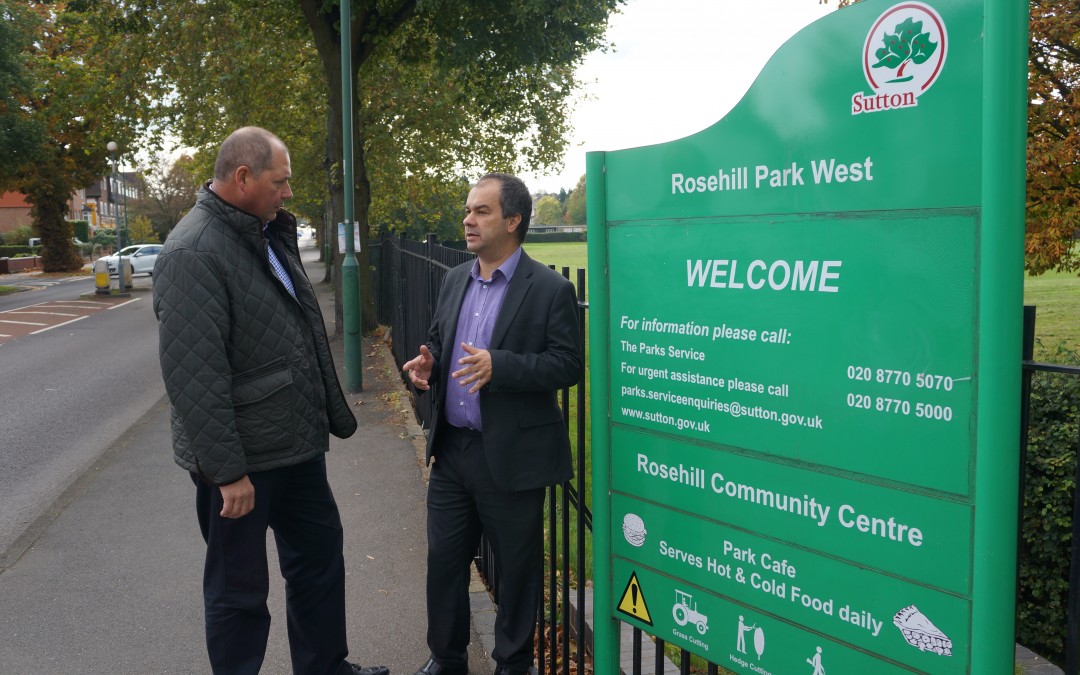
Today I spoke at a debate in Parliament about Secondary School places in the London Borough of Sutton. We are now less than two years away from a potentially disastrous situation where hundreds of children currently aged 9, will be left with no local school place. Before the election, I outlined my support for a school to be built on the derelict all-weather pitch in Rosehill Park. The Council were in discussions with the Greenshaw Learning Trust about this site, but abruptly and without warning pulled out from those discussions. I am extremely disappointed that the Council have behaved in this way. That sort of approach to negotiation runs the risk of alienating potential investors considering Sutton who may be put off by this lack of integrity in negotiating.
I am also disappointed that the Lib Dem MP for the neighbouring Carshalton and Wallington constituency, which makes up the other half of the London Borough of Sutton, not only failed to show up to the debate today, but later tweeted that he believes Sutton Council are on track with school place planning. This is simply untrue. We need a new school by September 2017 and there is currently not even an agreed site, let alone planning permission or the beginnings of any actual construction.
I was encouraged by the response from the Education Minister, Sam Gyimah MP, who said: “…I am seriously disappointed that the Council has since changed its mind about [the Rosehill] site and removed it as an option. Rosehill remains the preferred site for the Sutton free school due to size, access to playing fields and location for a much needed large 8 form entry secondary school.
“At this early stage we still have the opportunity to review the options for bringing forward two much needed secondary schools in Sutton, and I urge the Council to reconsider its plans to meet its basic need for secondary places.”
I am pleased that the Minister recognised that Sutton is going down a blind alley, playing politics with the education of our children. The Leader of the Council seems to be putting off politically difficult decisions until after the local elections in 2018 and has not ruled out building a school in Rosehill after that date anyway. We need the council to put politics aside and do the right thing for our children.
You can watch the debate here.
by Paul Scully | Nov 2, 2015 | News, News |
Recently I went on a fact-finding trip to Israel. We were told that we arrived with questions and that we would return with more informed questions. That was certainly true. There are no easy answers to the Israel/Palestine situation but we need to keep trying to find a solution – to my mind this has to be a two-state solution, with Israel and Palestine acknowledging the legitimacy of each others’ claim to land in the region. The recent stabbings in Jerusalem is a salutary reminder of how quickly tension can give way to violence and how far we are from coming to a solution.
Day 1 – Tel Aviv – Jaffa

The view of Tel Aviv from my hotel room, including mosque.
We travelled to our base in Tel Aviv. I wasn’t sure what to expect, but I’m pretty sure it wasn’t what I found. Tel Aviv is an incredibly cosmopolitan, achingly-trendy city based around the beach. Arabs represent about 20% of the Israeli population, so I should not have been too surprised to have walked past a number of mosques on our way to Jaffa, the old part of the city to the south of Tel Aviv. Listening to the call to prayer from one mosque, I wouldn’t have known that I was wandering around one of the most hotly disputed areas in the world. Tel Aviv is home to a number of technology start-ups with a young population. There was a palpable buzz around the place and a lot of building and regeneration work. I’d be keen to return to look around some more.
Day 2 – Erez Crossing, Gaza

Examples of rocket shelters
We travelled south to Netiv HaAsara, a small settlement on the border with Gaza. We heard from two young girls that live their lives in fear of rocket attacks. When the alarm sounds, residents have just 15 seconds to get into one of the many shelters dotted around the moshav (village). The kindergarten was totally reinforced to take pressure of the children there. However we heard how one elderly couple had to sleep in a shelter after the husband had a heart attack and would not be able to protect himself in time. We saw the opening of a tunnel that had been discovered last year. There are two types of tunnel, smaller ones to get men in and out quickly and ones big enough to drive a truck through in order to smuggle goods. From this vantage point we could see a Hamas training camp on the outskirts of Gaza City. Later on in the week we heard how bullets from the training camp had hit one of the closest homes to the wall, with Israel retaliating by bombing that same training camp.
The next stop was to Zikim, a nearby kibbutz on the coast which was the location of a Hamas terrorist raid last year. We saw one of the small boats that police the controversial blockade which aims to stop the import of weapons and materials that may be used for tunnelling. The kibbutz is one of the few remaining that work on socialist lines. Our host who arrived in Israel from San Francisco in 1971 explained how residents all got paid the same wage regardless of what work they did. Everything is pooled and they all eat together.
Then to Erez Crossing, the single crossing point between Israel and Gaza. We saw an expensive, underused crossing designed for 45,000 people crossing each day which has just a few hundred coming to Israel from Gaza on a daily basis. There are limited reasons that are accepted by the Israeli authorities before a pass is issued. However a number of lorries carrying freight do pass through with supplies. We saw a video of a woman who had been isolated before she revealed her bomb belt which was then detonated safely. Israel left Gaza ten years ago. Some Palestinians in Gaza destroyed much of the old Israeli infrastructure rather than use it themselves. At the Kibbutz we had seen aerial photography showing the marks of former buildings on the Gaza side of the barrier.
Empty rocket casings, some up to 5ft long
Our final visit of the day was to Sderot, the closest city to the crossing. This is where many of the rockets were targeted. We heard from Kobi Haroush who is in charge of security. Kobi showed us the carcasses of rockets that had rained down on the city, up to five foot long, many of which were stuffed with nails to cause extensive injuries. Regular alarms, explosions and the fear of following the 13 fatalities and dozens of injured has led to post-traumatic stress including miscarriages and 18 year-olds wetting their beds whilst on national service. The city lives in fear and a whole generation is being scarred.
Day 3 – West Bank, Palestinian Territories

This family from Ethiopia were one of many supported by Save A Heart
On our way to the West Bank we stopped off at the Save a Child’s Heart charity. Cardiologists in Tel Aviv perform major heart surgery on children from Gaza, Kenya, Ethiopia and elsewhere on a pro bono basis. The charity has recently opened a residential home for the children attending the hospital where they will often stay with their mothers for several months at a time. The surgeons train African doctors as well which builds capacity in their home countries. We met many of the children who were incredibly grateful for the help and support that they were getting from this inspirational charity.

Bashar-Al-Masri showing us the construction of Rawabi
We drove across the barrier to Rawabi, the first Palestinian-planned city in the West Bank. The project is designed to house 40,000 Palestinians in a well-designed series of building set on a steep hill. It has been funded by Bashar Masri, a successful Palestinian business man and Qatar. Residents had just started moving in as we visited. Some Palestinians are not happy as Israeli materials are being used, some Israeli settlers remain convinced that this was Israeli territory and so should not be built on for Palestinians. Both are wrong and I was pleased that the Israeli government did not support the illegal settlers in their controversial view. The rooftops of an Israeli settlement could be seen from the main office at the top of the hill, even though the view was partially obscured by a series of strategically placed Palestinian flags. Two issues have slowed progress. Protracted negotiations about water supply, left the city uninhabitable as there was no water. The small single access road is not enough to cope with traffic that will arise when the city is fully occupied. The Israeli government can help themselves by being proactive in helping with the road.
Our second stop in the West Bank was the Coca-Cola distribution centre in Ramallah. Zahi Khouri, the Palestinian CEO did not take the diplomatic approach of Bashar Masri when we spoke. Instead, he dismissed the rockets landing in Sderot as mere “fireworks” and complained about water-rationing despite having three water springs on site. There is no doubt that with there being two valid sides of this complex argument that there are plenty of examples of hardship and tragedy faced by Palestinians. However Mr Khouri’s partisanship whilst enjoying the benefits that having the exclusive franchise of one of the leading global brands, dented his credibility as a commentator on the ongoing conflict. Instead I was drawn to Bashar Masri’s positive approach, one that gives hope for his countrymen.
Day 4 – Jerusalem and the Knesset

Yoav Kisch, Likud Member of the Knesset
When we first flew over Israel, it suddenly hit me that I was looking down at the most hotly contested piece of land in the world. Visiting Jerusalem drove that point home.
We met three Israeli politicians from different parties. Tamar Zandberg from the Meretz Party squeaked into the Knesset at the last election as the fifth candidate on the list. It had looked as though Meretz would only get four seats and the party leader offered to sacrifice her own seat to allow rising star, Zandberg to take her place instead. As it happens after soldiers votes were taken into account which can often be counted late because of deployment, both were elected. Left-wing Meretz must really rate Zandberg as their future to make that sacrificial offer. We also met former El-Al pilot Yoav Kisch, another rising star, this time from the ruling Likud Party.

We were the first to meet Mark Regev after the news of his post to the UK as Ambassador
I chaired a meeting with Mark Regev. At that time he was a spokesman for Benjamin Netanyahu but had just been confirmed as the next Ambassador to the UK. He was an impressive individual; a doughty defender of Israel, with an unshakeable confidence in the Zionist cause but pragmatic as well. I am looking forward to seeing him in his new role and what he will bring to the UK in replacing Daniel Taub who has done much to help UK-Israeli relationships flourish.

The Church of the Holy Sepulchre with the Immovable Ladder just visible under the top right window
We were taken on a tour of the Old City. The King David Hotel overlooking the City, that was bombed by a militant Zionist organisation in 1946, reminded us of the beginning of the post WWII conflicts. In among the markets we came to the Church of the Holy Sepulchre.

Golgotha, the site of the crucifixion
Christians revere this as the site of Golgotha, where Jesus was crucified and his burial tomb close by. The keys to the church are entrusted to two Muslim families in order to ensure peaceful coexistence. To illustrate the difficulties of maintaining a church which everyone has a claim on, a small wooden ladder leaning up against a window above the facade, is a symbol which causes angst if ever moved. The ‘immovable ladder’ has remained in exactly the same place bar two occasions for two hundred years. The Greek Orthodox and Armenian Apostolic churches have been the prime movers in this somewhat absurd but incredibly tense conflict.
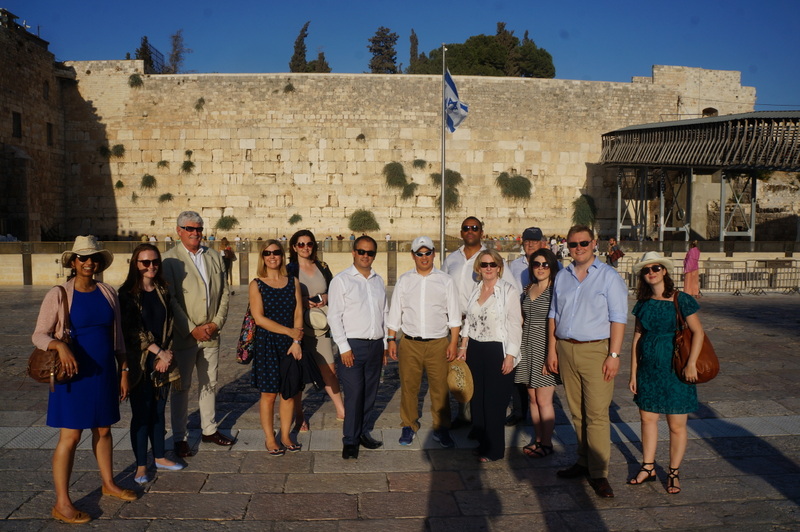
The Western Wall is the holiest site in Jerusalem. Donning a Kippah, we saw this impressive 62 foot high wall and had time to reflect on what has gone before us on this very site.

Reflecting on thousands of years of history looking across to the Temple Mount
Hundreds of small scrolls of paper were stuffed into the cracks in the wall. More than a million ‘kvitelach’, written prayers, are left each year. The wall was segregated with a women’s area on one side.

The Western Wall
A couple of us noted buildings offering food for the poor overlooking the wall. Competing signs including the names of the philanthropists, primarily American, suggested an ulterior motive for the worthy charitable work done there.
Day 5 – Yad Vashem and the Security Barrier
On the last full day, we travelled back to Jerusalem. We had been told that Yad Vashem, the Holocaust Museum in the city would be a heavy assault on our senses. Frankly, it was staggering. The architecture was such, that we were transported around a number of rooms, not knowing what was coming around the corner with the only natural light being as we ascended back to ground level at the end. This echoed the experience of Jews across Europe before, during and immediately after the Second World War. We learned about the slow lead-up to the mass deaths of the camps, the corralling of Jews into ghettoes, stripping them of possessions and dignity. We saw how structured the process was, taking different approaches to different cities across the continent and how horrifically industrialised the death camps became, killing 5,000 people each and every hour. I was born 23 years after the end of the war but remember clearly how raw it was for that generation of Brits who had faced the Nazis. How much more it must have been for those who were systematically targeted, not for battle, but for mass slaughter and extermination. Although I was expecting it, I was still shocked to the core by what I saw and heard.
Our guide was simply excellent. The headset system that we had meant that our group didn’t need to crowd around. She could talk in a hushed, respectful tone sharing her deep knowledge and impassioned interest in the personal stories. The last room in the main museum was the Hall of Names. Pictures of many of the dead circled above our heads and files containing short biographies of 2 million Jews killed in the Shoah struck everyone’s hearts, driving home the lasting impact that this horrendous period in history had on Jewish people. The enormity of the research that must have been undertaken to complete this project was incredible. Our visit to Yad Vashem towards the end of our trip, neatly encapsulated the reason for the rocky journey that Jews had been on in establishing and maintaining a Jewish homeland.

The panoramic view at Yad Vashem, hope after the harrowing experience of the story of the Shoah
On reaching the panoramic view on our return to ground level, we had two more rooms to visit. The Children’s Memorial is a hollowed-out cavern. The names of some of the estimated 1.5 million children murdered in the Holocaust were read out along with their age and country of birth whilst we walked through a dark room with candles being reflected around us creating the impression of millions of stars. We then led a short memorial service in which my colleagues laid a wreath and lit a flame to share our sympathies and our commitment to remember so that such a tragedy can never be repeated.
Our afternoon was spent with Colonel Dany Tirza who showed us the security barrier that he designed and built which divides Israel and the Palestinian Territories. 95% of the security barrier is fencing, rather than the more oppressive wall that is usually shown in the media. Fencing with cutting-edge pressure sensors surrounded by ashphalt to track anyone seeking to sneak over works in most areas where there is a significant gap between properties. The wall in Jerusalem was constructed where Palestinians and Israelis are separated by only a matter of centimetres.

Overlooking Bethlehem from a vantage point previously under sniper fire
We looked over to Bethlehem which had been the location of a lot of sniper fire. Dany explained how residents in the block of flats behind us had to live in the back of the property rather than the front, unable to open the fridge at night for fear of the light going on and attracting gunfire. Frankly I was amazed that anyone remained in the flats under those conditions. He explained how he and his staff had walked all 700km of the route of the barrier in order to see first hand the possible effects and had mitigated them as much as possible by building around buildings and controversial areas rather than resorting to demolition or cutting through such areas. This had been tricky for such sites as the tombs of Rachel and Lazarus. The former has its own guarded access route. Similarly the area around a university was so controversial, Dany received a call from former US Secretary of State, Condoleeza Rice, lobbying for change. This part of the trip really highlighted the lasting divisions and the continuing mistrust between the Israelis and Palestinians. However, the seriousness of the situation was broken up by Dany’s love of telling elaborate stories, a talent shared by many Jews that we encountered in Israel.
We concluded the day by visiting the Founding Editor of the Times of Israel, David Horovitz. It was David who broke to us the news about the gunfire in Netiv HaAsara, the village we had visited on the first day. We asked about other local stories but it seemed clear that the Palestinian-Israeli tension in all of its facets was the single driver of the news across the country.
Over the week, we also met our new Ambassador to Israel, HE David Quarrey and Deputy National Security Advisor Eran Lerman. They added further context to our visit, giving us a much more rounded view of the situation. Our opening advice was 100% correct. I have not come back with any easy answers, but many, hopefully more informed, questions. There are two sides to any conflict. Illegal settlements in the West Bank serve only to exacerbate the situation. But the terror faced in places like Sderot is real. Israelis should be able to live without fear of the 15 second warning, barely enough time to read this paragraph. Benjamin Netanyahu made an offer on his visit to London that he would return to the negotiating table without pre-conditions. He was clear about the first thing that he would be looking for – Palestinian acceptance of Israel’s valid claim to territory in the region, the right to exist. But that would come at an early stage in talks, not in advance. One thing is clear, talks are the only prospect of a two-state solution. Both sides need to recognise each other’s claims. A demilitarised Palestinian won’t be enough. That simply reinforces Israel’s role of custodian in an area that we should be able to recognise in time as an independent Palestinian state. Indiscriminate rocket fire, terror tunnels across the border with Gaza and the recent stabbings will only serve to harden opinion and make a solution even further away. Israel is a democracy that has every right to exist and flourish without fear from those dedicated to ‘push it into the sea’ supported by some of the most tyrannical states in the world. Some hard-liners may be satisfied with continuing conflict. The UK needs to play its part as a critical friend of both Israel and Palestine and help bring the two together. We need to remain optimistic, even when things look difficult. The alternative does not bear thinking about.

by Paul Scully | Oct 30, 2015 | News |
Working in Parliament I commute in and out of London almost every day. Like everyone who also uses trains across Sutton, Cheam and Worcester Park, I am incredibly frustrated by the constant delays and cancellations.
Despite being offered refunds on delays lasting over 30 minutes, I don’t see any improvements in the running of the services.
On 3rd November, I will be meeting with Directors of Southern Railway to discuss their services and I am crowdsourcing questions from residents to ask Southern when I meet them.
What do you want to ask Southern Railway?
Please email me and let me know your questions at info@scully.org.uk.
I will be having further meetings with Thameslink and South West Trains in future, and I will also ask for your feedback when they come around.
by Paul Scully | Oct 29, 2015 | News |
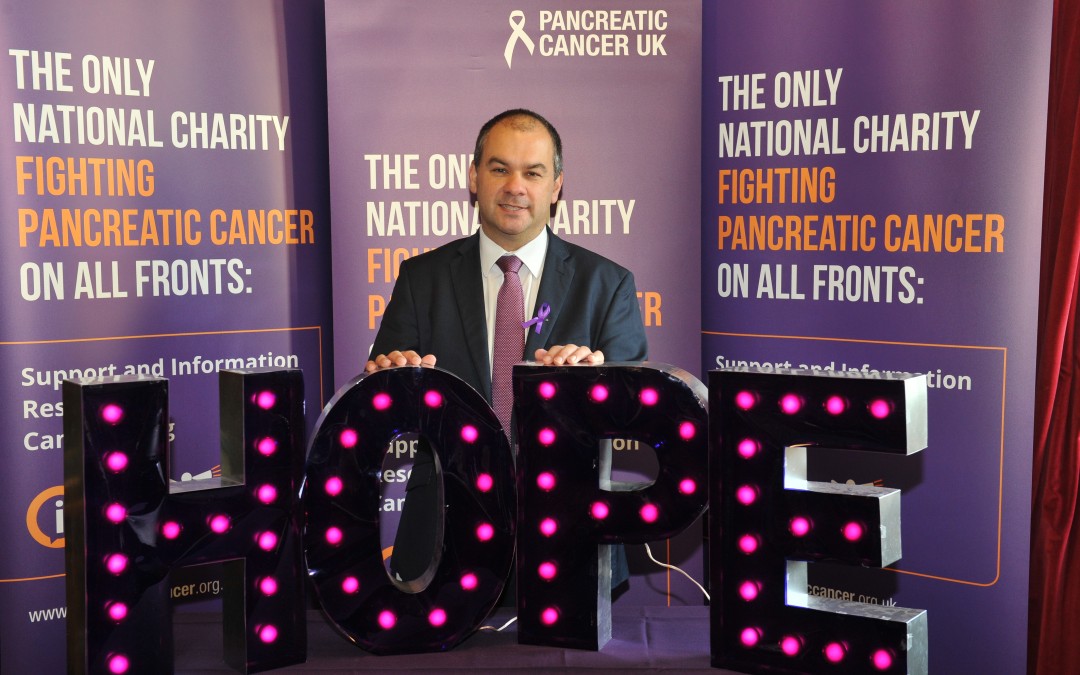
Yesterday I attended a cross-party event at the House of Commons, organised by Pancreatic Cancer UK, to help spread the word about pancreatic cancer ahead of pancreatic cancer awareness month.
It was only after the partner of a friend of mine was diagnosed with pancreatic cancer that I realised how serious this illness is, yet how low the survival rate is. Tragically, only four per cent of patients live for five years or more after diagnosis. In addition to learning about these dreadful survival rates, I heard about the need for earlier diagnosis, more research funding and better access to new treatments for the disease, as well as the work being done by Pancreatic Cancer UK to fund its own research and provide support for patients and their families around the country.
There were nearly 8,800 new cases of pancreatic cancer diagnosed across the UK in 2013, 843 of whom live in London. In Sutton, there were 27 new cases recorded in 2013, and 22 died in 2014.
I was joined by patients and family members of those affected by pancreatic cancer, as well as specialist nurses and representatives from Pancreatic Cancer UK. MPs were told about the many local supporters taking part in Pancreatic Cancer UK’s Purple Lights for Hope events on November 1st.
Pancreatic cancer is the fifth most common cause of all cancer deaths in the UK and currently has the lowest survival rate of all the 21 common cancers. One person dies every hour of the disease, and it is predicted that by 2030 pancreatic cancer will overtake breast cancer as the fourth most common cancer killer.
It was a pleasure to attend this event organised by Pancreatic Cancer UK, to learn more about the work of the charity and the support and research it funds. Sadly, the survival rate for pancreatic cancer speaks for itself. I know there are many people within my constituency who have been touched by pancreatic cancer and we need to do more to improve awareness of the disease, its signs and symptoms, and do more to radically improve the shockingly low survival rates. That’s why I’m supporting the charity and its Purple Lights for Hope campaign as part of pancreatic cancer awareness month this November.
Alex Ford, Chief Executive of Pancreatic Cancer UK said: “We were delighted to welcome Paul Scully MP to this important event and we thank him for his support. We hope he will help us spread the word about pancreatic cancer far and wide this November.
“It’s shocking that the number of people living for five years after diagnosis with pancreatic cancer is still just four per cent, and that figure has barely improved in the last 40 years. Yet across the UK, we know so little about the disease. We all have a role to play in raising awareness of this dreadful cancer, so people know the signs and symptoms to watch out for. I would urge local people to find out more about the disease today.”
For more information about pancreatic cancer, visit www.pancreaticcancer.org.uk.
by Paul Scully | Oct 28, 2015 | News |
I have secured a debate in Parliament on 4th November to discuss the school place crisis in Sutton directly with a Minister from the Department for Education.
If a new school isn’t ready by September 2017, more than one hundred children currently age 9, risk finding themselves with no school place in just two years’ time. The situation gets worse in 2018, with 16 forms of entry needed, so nearly 500 children will be without a school place unless two new schools are ready. I am calling for immediate action to be taken so our children have a good local school to go to, and a bright future ahead of them.
In government we’ve taken the Local Authority out of education, leaving it to the experts – the teachers. The only thing Sutton councils has to provide is Special Educational Needs facilities and school place planning – and they can’t even get that right!
The Sutton Hospital site is only a fifth of the size needed for a new school in Sutton. Sutton’s Lib Dem Councillors are playing politics with our children’s future and are trying to cover up their financial blunder of spending £8 million on a site that every study shows is desperately inadequate.
Before the election I made it clear that I wanted a new school to go on the site of the disused all-weather pitch on Rosehill, which was supported by Greenshaw Learning Trust who have been charged with building the school. In a display of shocking behaviour, Sutton Council abruptly ended negotiations with them over this site, which is not only big enough, but is also in the area of the Borough where school places are needed most.


