by Paul Scully | Apr 18, 2013 | News |
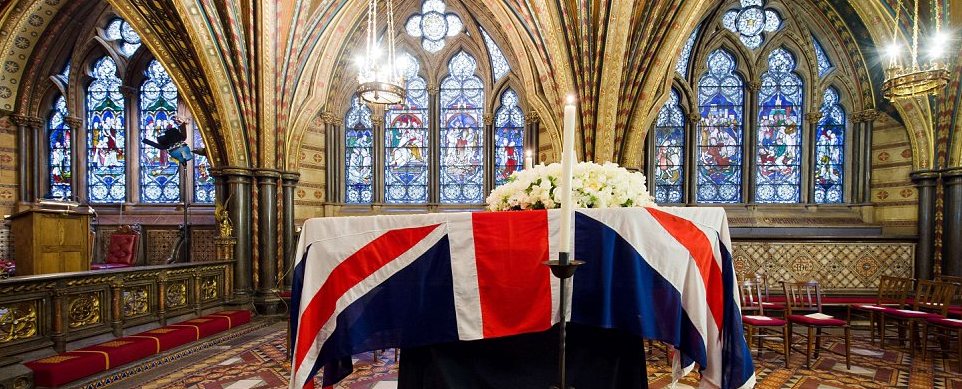
 I joined many thousands of people lining the streets of London yesterday to pay my last respects to Baroness Thatcher. Standing outside the Royal Courts of Justice, we saw the gun carriage pass us just after the coffin had been transferred at the Church of St Clement Danes as shown in the snatched photo. This is the central church for the RAF and was a fitting stopover for the event which had the military centre stage.
The atmosphere was one of respect and gratitude. A couple of protestors made their point with one being put in their place by an elderly gentleman and another dressed as a miner, succumbing to the convivial atmosphere and having a souvenir photo taken with her arms around a policeman. A particularly touching moment was when spontaneous applause broke out and accompanied the procession along The Strand and Fleet Street like an aural Mexican wave. My group watched the service in a nearby pub, surely one of the few times a West End pub has had choral music blasting out of its surround sound system.
I wanted to attend for a number of reasons. Yes, this was a historic day and being a part of the pomp and ceremony that Britain does so well is very special. However this was a chance to mourn the passing of one of our greatest prime ministers and to thank her for her achievements which helped spur me on to get involved politically myself. The thousands of doors I have knocked on, the tens of thousands of leaflets that I have delivered were largely the product of my upbringing in the Thatcher years.
The wall to wall coverage has gone through the differences of opinion with a fine tooth comb. As we’re approaching Thatcheration point, I’ll leave it to others better qualified than I to write in detail about her time in office and its effects on our country. However there are two areas that I have pondered about over the last week. It is difficult for many to remember quite how bad the state of the country was in 1979 when I was aged 11. We look upon Greece and Cyprus as ‘basket cases’, but the UK was in much the same position then. People couldn’t take more than £50 of their own money out of the country when they went on holiday. To get a phone or gas cooker installed people had to wait for months. 29.5 million days were lost to strike action in 1979. It took someone with the courage of their convictions and the determination to plough through regardless to make even a small dent in the situation. It took Margaret Thatcher to smash through the system.
Another myth that has been allowed to develop is that Margaret Thatcher did not believe in society. Her speech has been quoted so far out of context but I am pleased that the Bishop of London sought to address this in his excellent sermon. The society whose existence she denied was not communities, families and groups brought together with common laws, customs and principles. It was an empty word, a lazy substitution for “someone else, anyone else” which inevitably ended up as the State that she believed had replaced the real meaning of society. That is just as true today as it was then. This is not about self-obsession, clambering over others to get what you can out of the world. It is about realising that we are all individual components in our society, our community and we all need to be playing a role and taking responsibility for what we can to keep the well-oiled machine working effectively.
Whatever your views, she was elected three times. Listening to some of the coverage, it is easy to think that no-one voted for her rather than the 13.7m in 1979, 13m in 1983 and the 13.7m in 1987. I did in 1987, the first election in which I could vote and I am grateful for what she achieved on my behalf.

by Paul Scully | Apr 13, 2013 | News |

Around 38,352 people in Sutton & Cheam are benefiting from the biggest income tax cut in a generation this April.
On 6th April, Conservatives in government increased the amount of money people can earn before paying any income tax to £9,440 meaning 24 million people across Britain will pay up to £600 less income tax this year than in 2010.
An estimated 3,155 people who live in Sutton & Cheam will have been lifted out of income tax altogether by this government. Together with tax cuts made since 2010, Conservatives will have taken 2.2 million people across the country out of income tax.
The coalition agreement stated that by the end of the Parliament, the first £10,000 of people’s incomes would be tax free. Following the announcement in the recent budget, this is a promise that will be met next April. As well as taking the lowest paid out of tax entirely, this cut benefits all income tax payers. By next year, the personal allowance for income tax (your slice of income for which you pay no income tax) will have been increased by a whopping 54% by this government:
- 2010/11 – £6,475
- 2011/12 – £7,475
- 2012/13 – £8,105
- 2013/4 – £9,445
- 2014/5 – £10,000
This is obviously great news for people in Sutton & Cheam. Whilst the government has to keep making tough decisions to balance the books, it is right that Conservatives have prioritised hardworking people – rewarding those who want to get on in life by letting people keep more of the money they have worked hard to earn. Extending the number of people who can still work without paying any income tax leads to a fairer tax system and helps in the aim of always making it pay to work.
Constituency figures from HM Treasury, December 2012

by Paul Scully | Apr 12, 2013 | News |

I joined Cllr Eric Allen and Steve O’Connell for a walkabout around Cuddington Rec’ yesterday to see where the proposed perimeter park will go following the announcement of £100,000 funding from Boris.
Local residents Barry Ivens and John Weir have long campaigned alongside Eric to secure this money and it was good to see their work bear fruit. Their Friends of Cuddington Park Group bid for a further £5,000 in a local council participatory budgeting exercise. The next step is for the council to consult residents on the plans.
One thing I have noticed about the local area is how the council often does half a job and forgets about Worcester Park and North Cheam in favour of Sutton town centre and Carshalton. The pathway at the St Clair Drive entrance which just suddenly fizzles out into a patch of mud sums it up really. If Barry, John, Eric and Steve can get the job finished, it will encourage cyclists and others to make better use of the extremely attractive park.

by Paul Scully | Mar 5, 2013 | News |
 I spent the weekend in Moldova leading a seminar on behalf of the Westminster Foundation. This is an organisation that connects politicians from across the world and has been instrumental in helping democracy flourish in parts of Eastern Europe and the Middle East. Moldova is a small country, Europe’s poorest, nestled between Romania and Ukraine. It is emerging from the shadow of decades of Soviet control. The journey from the airport immediately brought home the effects of Russian dominance with Soviet style apartment blocks dominating the streets into the city.
Although the Communists remain the largest party in Moldova, the government is a coalition led by the Liberal Democratic Party of Moldova (LDPM). Confusingly two of their coalition partners are the Liberal Party and the Democratic Party. The LDPM are a sister party of the Conservatives, sitting on the centre-right of the political spectrum. Though the capital city, Chisinau, was dour, the people were anything but. The members of the young political party were eager to learn and proud to show the work that they had already done, reflecting what they had picked up from previous visits to the Conservatives in London.
I was there with a colleague and Cheam resident, David Park, to talk to them about selecting candidates for elections. David has been instrumental at a number of levels in selecting prospective Conservative Members of Parliament and of course, I have just gone through the process myself so we performed a double act of selector and selectee.
The differences were huge. The challenge was how to take the best from the UK and make it applicable in the very different and restrictive system in Moldova. They run a closed list system with 110 candidates put on a party list and ranked by the people at the top of the party. This means that electors vote for a party but have no say in which individual becomes an MP and they have no personal connection. The clear drawbacks to this system are that it encourages patronage from the leaders and little belief from residents that they can have an influence in decisions that affect them locally. Less obvious but very real problems are that candidates are not motivated to campaign for any significant length of time, with people being placed on the list sometimes just a fortnight before the election. This is very alien to people in the UK…except those who actually understand the way that we elect our Members of the European Parliament and some of the members of the GLA. Although UK parties don’t as far as I know rely on patronage from their respective leaders to rank their candidates, the vast majority of voters have little say, control or understanding on who gets elected and why.
For me personally, the trip was a rare opportunity to experience a place that I previously knew little about and meet many dedicated, friendly people. Secretary General of the LDPM,Victor Rosca and his committed team will go far. They need to. Just two days after I returned the LDPM Prime Minister, Vlad Filat lost a vote of no confidence leading to uncertainty as they scramble to arrange a new coalition. If they do not secure this, an early election will be in the offing, leading to a far too premature test for our conclusions on candidate selection.
Now I just need to work out how to explain to colleagues that I’ve been helping the Liberal Democrats with campaigning!
by Paul Scully | Feb 28, 2013 | News |
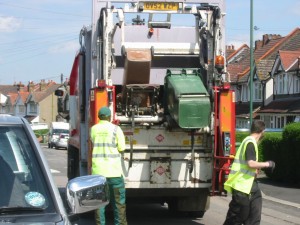
 I was thinking of recycling, as you do (well, politicians and environmentalists do) and I searched for some old research that I had done into Sutton’s recycling figures a few years’ ago. I found this old photo showing a brown and green bin both being emptied into the same place after a resident had gone to the trouble of separating their rubbish and wondered what the council was doing now; if it was leading the way in reuse and recycling as many residents might think. I was surprised by what I found.
In 2002, Sutton council had the second best recycling figures in London with 28% of household waste being composted or recycled. This has gone up to 37% in the last decade, below the London average and Sutton has been overtaken by several boroughs, ending up 10th in the capital’s league table.
We have been in the 30 per cent bracket now for nearly a decade and things appear to be standing still whilst everyone around us is getting better. This council were seen as the bright young things, but they are ageing rapidly, and they have not kept up. We need to look at other boroughs and how they encourage recycling. Bexley recycle more waste than they put in landfill.
I spoke to the Sutton Guardian on this matter after they picked up a tweet of mine saying: “Look at Bexley. They have been top of the table from the start, what are they doing right? And why are we not opening a dialogue with them to find out?”
The Deputy leader of Sutton Council told the Guardian: “Recycling is only one of the tools we employ as part of a sustainable waste management system.
“Recently, our approach has been to develop other areas such as reducing the amount of waste produced by households (we are collecting less this year than last despite housing growth), promoting home composting, working with charities which collect textiles and other materials and looking at the environmental impact of our waste management services and practices.”
“Waste management must also be assessed using a range of factors. Recycling is one but value for money and resident satisfaction are just as important. We have very economic services and we also achieve very high resident satisfaction.”
With the plans for the incinerator due to be considered by the council’s Development Control Committee next month, it looks like they are giving up on recycling and going to burn it instead.

by Paul Scully | Feb 28, 2013 | News |
 Today I had a letter published in the Sutton Guardian, welcoming the referendum pledge by the Prime Minister and setting out my views. Here’s the full text:
“Eight out of ten people in the UK want to have their say in the UK’s future relationship with the EU.
We now have the first real commitment in forty years to have an in/out referendum which should not be dismissed (Letters 14th February).
Unlike the Prime Minister my default position is to leave the EU unless I can be persuaded that renegotiated terms are of significant benefit to this country. Such a renegotiation will undoubtedly be tough but not impossible. Few believed that David Cameron would lead the way in securing the first budget cut in the history of the EU; but he did.
Pragmatists on both sides of the European debate will understand why such a referendum has to be held after the next election. We have a coalition government. The Liberal Democrat shift from wanting a referendum in 2010 to rejecting the idea now makes the necessary legislation impossible to get through Parliament.
UKIP has chimed with a section of the public as a pressure group but as a party, risks pushing the country further away from its stated aims by helping to usher in a return to government by the people who negotiated the Lisbon Treaty, lost control of our immigration system and ran up a huge bill for our children to pay back in decades to come.
I know that when the referendum comes, the answer will impact on this country for at least the next 40 years. With polls swinging either side of the 50/50 mark as to whether to leave or remain, we need to make sure that the public has a clear understanding of the options and we simply have to get that answer right.”
Whatever your view, I believe that this is a sensible pragmatic approach to ensure that we actually see some action. Yes, it means that we’ve got to secure an outright Conservative majority in 2015 but as David Cameron is the only leader promising a referendum that would be true at any given point in time. Whether you favour staying in the EU believing that it is important to be part of the biggest trading bloc in the world or want to leave, taking the view that Britain could and should establish trading links with other economies, reconnect with the Commonwealth countries and can forge a new relationship with Europe, David Cameron’s promise is the only way that you are going to get a say in the matter. It’s worth a short wait and the work involved. It’s not before time.

 I joined many thousands of people lining the streets of London yesterday to pay my last respects to Baroness Thatcher. Standing outside the Royal Courts of Justice, we saw the gun carriage pass us just after the coffin had been transferred at the Church of St Clement Danes as shown in the snatched photo. This is the central church for the RAF and was a fitting stopover for the event which had the military centre stage.


